
Learn more
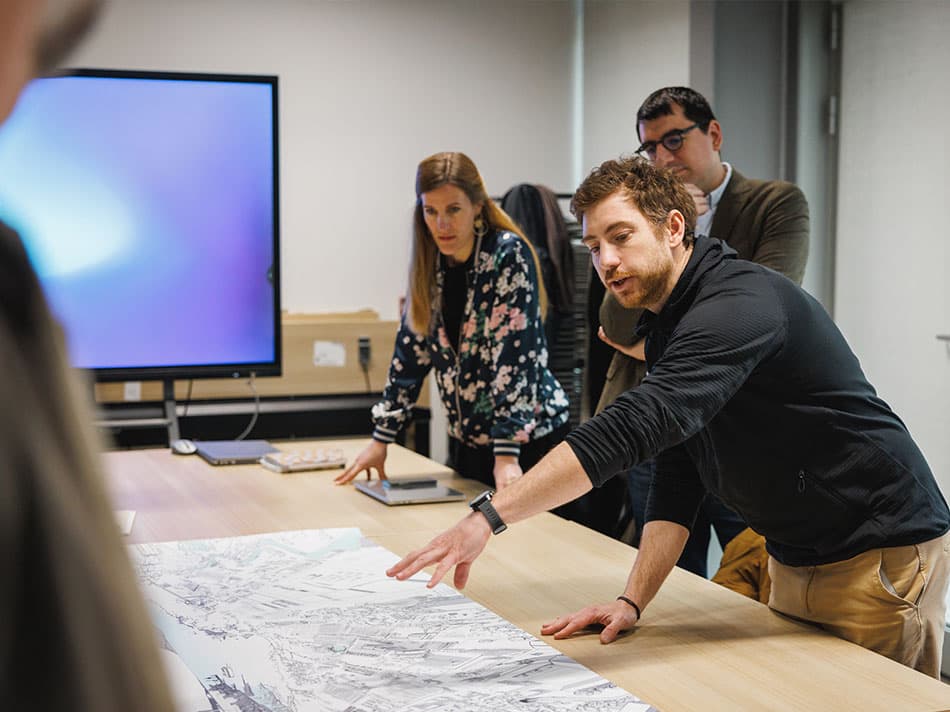

Informing your decisions, structuring your initiatives, and acting at the territorial scale
Learn more
APESA supports local authorities and public actors in their environmental, social, and economic transitions, with a systemic, collaborative, and operational approach.
We help them understand complex issues, facilitate multi-stakeholder initiatives, assess impacts, and build responses suited to territorial realities.
Local authorities and public actors today must make progress on increasingly interconnected topics: ecological transition, resource management, adaptation, regulation, support for diverse economic models, territorial cooperation, stakeholder mobilization, and operational feasibility.
These issues cannot be effectively addressed in silos. They require a comprehensive perspective, strong analytical capacity, dialogue among the actors concerned, and methods that turn complexity into clear, actionable decisions.
APESA acts as a partner for analysis, structuring, and support. We help local authorities and public actors objectify their issues, clarify their choices, produce useful deliverables, and move forward with initiatives that are often complex to manage.
We bring together technical, environmental, social, economic, and territorial dimensions to avoid partial responses.
APESA does not stop at theoretical diagnosis. We combine knowledge production, operational support, experimentation, and knowledge transfer.
We support local authorities and public actors with rigor, clarity, and feasibility, in the service of robust projects that are useful to the territory.
We pay particular attention to local contexts, stakeholder dynamics, governance constraints, and the real conditions of implementation.
Decision support and understanding of complex situations
We help local authorities and public actors structure a diagnosis, objectify an issue, analyze scenarios, and build suitable responses.
Environmental and societal transition
We work on issues of impact, trajectories, circular economy, territorial transition, evaluation, and project structuring.
Waste, bioresources, and resource valorization
We support topics related to waste management, bioresources, composting, anaerobic digestion, and biodegradability.
Facilitation, training, and awareness-building
We can also help teams build skills, support the understanding of a topic, or facilitate the coordination of multi-stakeholder initiatives.
01
Starting from the real territorial context
We analyze the project framework, the objectives, the constraints, the stakeholders involved, and the available room for maneuver.
02
Combining different perspectives
We bring together the technical, regulatory, environmental, economic, social, and organizational dimensions.
03
Producing deliverables useful for decision-making
Diagnoses, scenarios, analyses, recommendations, decision-support materials, or framing tools: we always aim for concrete usefulness.
04
Bringing actors into dialogue when necessary
In some projects, the quality of the outcome also depends on the ability to bring different approaches into dialogue. We can contribute to facilitating this discussion.
05
Facilitating the transition to action
We help translate findings into priorities, actions, and a clear path forward, paying particular attention to team ownership.
In territorial projects, difficulties often arise from a lack of shared framing, overly siloed diagnostics, difficulty prioritizing, or a gap between stated ambition and actual implementation capacity.
Clarifying issues and objectifying choices
Better connecting expertise and consultation
Making decisions more robust, building more consistent initiatives over time.

Understanding a complex territorial context and producing a structured, rigorous analysis
Connecting expertise and feasibility, supporting decision-making without oversimplifying
Supporting multi-stakeholder projects
Strengthening ownership and skill development.
APESA helps understand, objectify, and structure complex issues by combining technical expertise, a systemic approach, field knowledge, and operational support.
Yes. APESA can support initiatives involving multiple stakeholders, paying particular attention to the quality of framing, the clarity of issues, and feasibility.
APESA can support various types of public actors: local authorities, joint associations, public institutions, agencies, or territorial organizations.
Yes. Training can complement support when it is important for teams to understand the issues and build their skills.
APESA can work on decision support, territorial transition, evaluation, resources, waste, bioresources, circular economy, training, and more.


3 chemin de sers, 64121 Montardon, France
contact@apesa.fr
Follow us →